
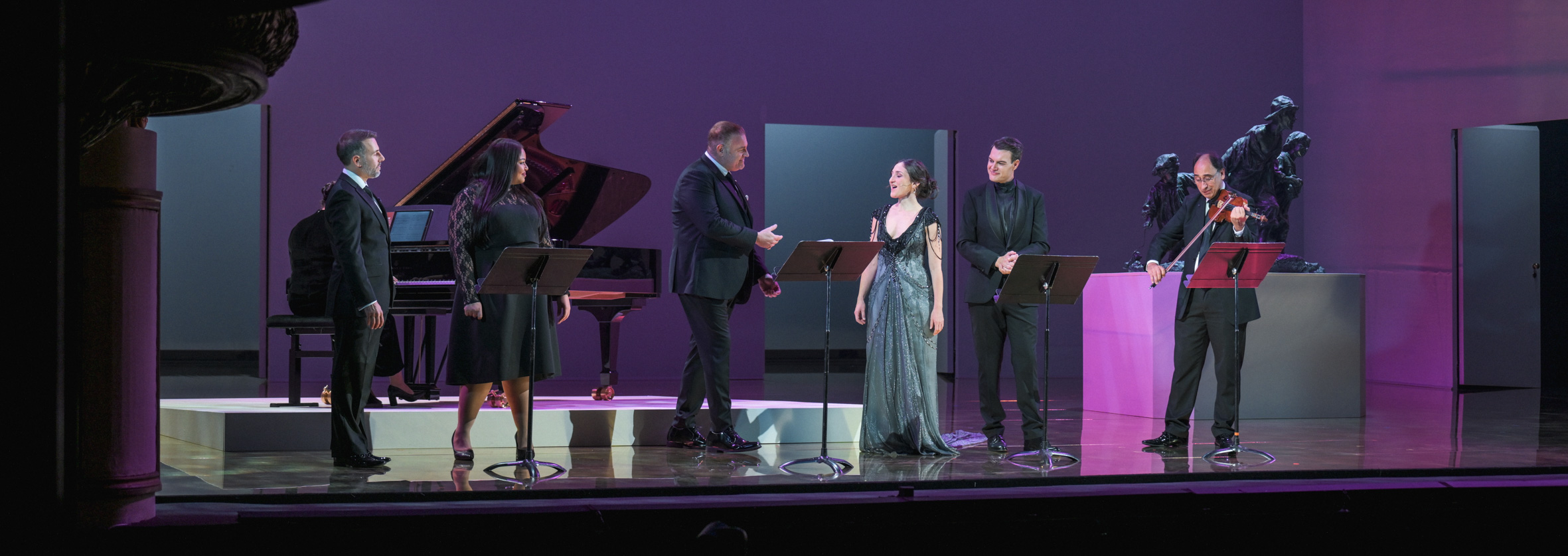
Opéra national du Rhin, 4 November 2025 – In Strasbourg, a cradle of reconciliation, Malta’s voice rose with clarity and warmth — a reminder that harmony is not a given but a living act, sustained through listening, understanding, and hope.
On 4 November 2025, the Opéra national du Rhin lifted its curtain to an evening of unity and reflection as Malta presented Malte Chante l’Europe – une voix d’unité, a gala concert marking the 75th anniversary of the European Convention on Human Rights. Organised by the Permanent Representation of Malta to the Council of Europe, the event formed part of Malta’s Cultural Programme for its Presidency of the Committee of Ministers — a moment where diplomacy met art in a shared European celebration of freedom, dignity, and peace.
The concert was attended by H.E. Myriam Spiteri Debono, President of the Republic of Malta; Mr Alain Berset, Secretary General of the Council of Europe; Mr Theodoros Rousopoulos, President of the Parliamentary Assembly; Mr Mattias Guyomar, President of the European Court of Human Rights; Hon. Jonathan Attard, Malta’s Minister for Justice and Reform of the Construction Sector; and the Permanent Representative of Malta and President of the Committee of Ministers, H.E. Francesca Camilleri Vettiger.
Featuring a stellar ensemble of Maltese talent — Joseph Calleja, Carmine Lauri, Maria-Elena Farrugia, Nico Darmanin, Cliff Zammit Stevens, Destiny Chukunyere, and Mariele Żammit — the programme journeyed through Europe’s musical soul: from Handel’s serene Ombra mai fu to Puccini’s E lucevan le stelle. Alongside these came Maltese compositions by Charles Camilleri, Joseph Vella, Dominic Galea, and Mary Anne Zammit, each adding the colour and cadence of the Mediterranean.
The evening also marked several historic firsts. For the first time, Charles Camilleri’s “Pawlu ta’ Malta” — inspired by Oliver Friggieri’s words — was performed beyond Maltese shores by Joseph Calleja, its moral and spiritual depth resonating powerfully in the heart of Europe. And, in a groundbreaking collaboration, Joseph Calleja performed għana — Malta’s traditional folk singing, recognised by UNESCO as Intangible Cultural Heritage — live on the Strasbourg Opera stage, joined by Mariele Żammit and Carmine Lauri in Lament Malti. It was the first time Malta’s centuries-old folk tradition was sung at this prestigious venue, uniting opera and għana in one breathtaking dialogue of cultures.
The concert’s scenography was anchored by the original cast of Les Gavroches (1904), the bronze masterpiece by Antonio Sciortino, Malta’s foremost sculptor of the twentieth century, brought to Strasbourg through the collaboration of Heritage Malta and the Malta Society of Arts. Placed centre-stage, the sculpture’s depiction of youthful courage and dignity stood as a silent companion to the music — a meeting between Malta and France, Victor Hugo and Sciortino, art and humanity.
As the evening drew to a close with One Day More from Les Misérables, the image of Les Gavroches illuminated behind the chorus became an emblem of Europe itself: fragile, fearless, and united through shared ideals.
In her welcoming remarks, Ambassador Francesca Camilleri Vettiger reflected that,
“Malta Sings Europe is both a celebration and a commitment. It reminds us that Europe’s true harmony lies in its diversity — and that our shared song continues to evolve with each generation.”
Artistic Director Sean Buhagiar captured the spirit of the night in his note:
“It was a great responsibility to honour the 75th anniversary of the European Convention on Human Rights during the World Forum for Democracy. We chose to sing. To answer history with music, with voice, and with a sculpture of three children who still speak to us in silence. Sculpture will not fix our contradictions, but it gives them form. When we sing each other’s songs, we remember what it means to be human. To listen – that is the simplest, and most radical, act of all.”
Through every aria, folk verse, and light hitting a sculpture, Malte Chante l’Europe became more than a concert — it was Malta’s gift to Europe: a promise, sung in many tongues, that art will always be the quiet defender of freedom.